 |
JAPANESE PRINTS
A MILLION QUESTIONS
TWO MILLION MYSTERIES
Ukiyo-e Prints浮世絵版画 |
|
Kansas City, Missouri |
|
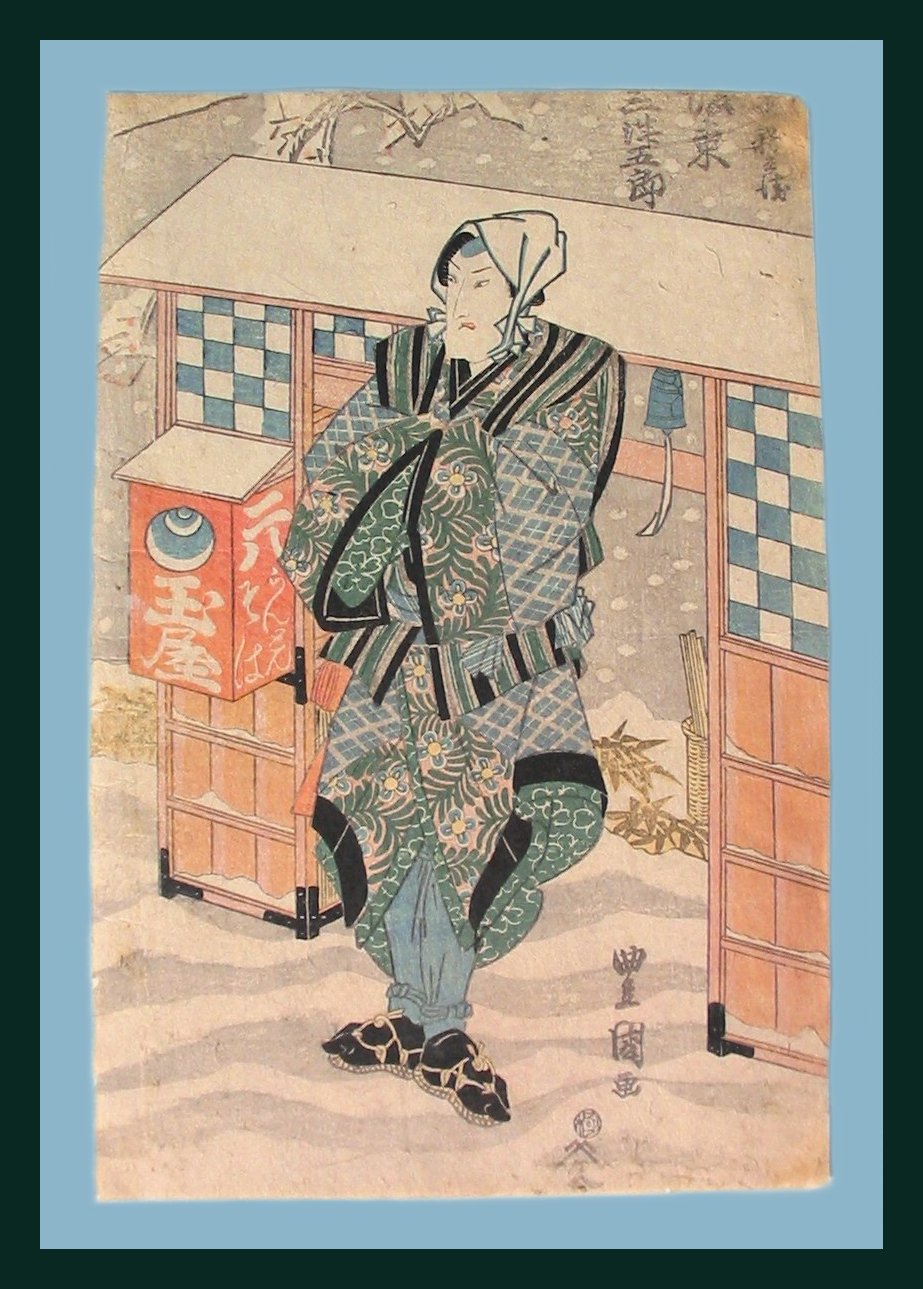
UTAGAWA TOYOKUNI I 歌川豊国 1769-1825 The actor Bandō Mitsugorō III (坂東三津五郎) as Tamaya Shinbei standing in front of a noodle stand (玉や新兵衛)
Play:
伊勢平氏摂神風
Theater:
Signed: Toyokuni ga Publisher: Yamamoto Heikichi 版元: 山本平吉 1818, 11th Month Bunka 15 文化 15 SOLD! THANKS S! |
||
 Ise Heiji Hiiki no Kamikaze
|
There is another copy of this print in the collection of the Ritsumeikan University. Although our example shows a lot of wear it is much more complete than theirs. Also it would appear that this is only one panel of a multi-panel composition. |
|
|
|
|
|
|
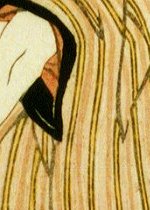
Above is a detail from another print by Toyokuni I showing a different actor in the role of Shinbei in a summer robe. Note the stripes. The striped robe may have been a convention common to this character. The print on this page includes a striped garment. |
|
|
|
|
|
|
|
||
|
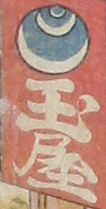
玉 屋 Tamaya can indicate the name of a jeweler or it could simply indicate a family or business name. |
|
|
|
|
|
|
|
|
|
そ ば |
う ど ん |
|||||
|
Soba |
Udon |
|||||
|
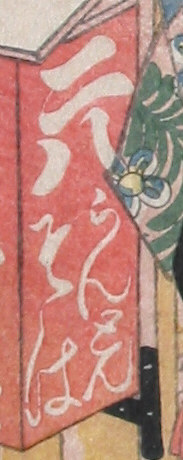
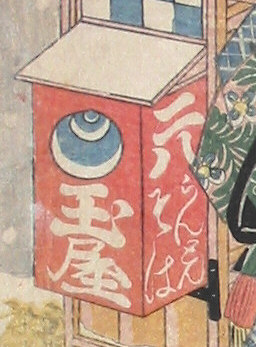
Above is the signage advertising the noodle stand. The text reads: nihachi udon soba |
|
Shown above is an andon or lamp typical of this type of stand. You will notice the flap which can be raised so a candle can be inserted and lit within. At night the characters shown on the box would transluce and help attract customers much as neon signs would today. |
||||
|
"Transluce" is an obsolete and rare word unused since the early 17th century, but I thought it looked appropriate and good here. So, why not? |
||||||
 |
||
|
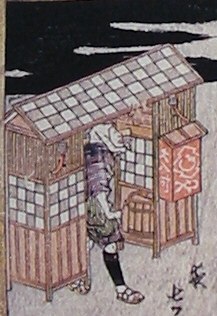
Kunisada noodle salesman circa 1820 |
|
SOBA AND UDON |
|||
|
蕎麦 |
饂飩 |
||
|
そば |
うどん |
||
|
A Japanese friend of mine came over to cook me dinner. Afterwards I was showing him some of my prints. When he saw this one he began telling me things about it which I did not know. Reading the Hiragana on the andon shown above he pointed out the script for the soba and udon elements which immediately became clear to me. What puzzled him was the "nihachi" (二八) part. The next day he called his mother in Tokyo and she cleared it up for us.
Anyone familiar with the distinctions between regional cuisines such as Northern Italian vs. Southern or deep dish Chicago pizzas and those made elsewhere knows what I am talking about. My friend's mother told him that the "nihachi" (二八) was an expression of proportionality which traditionally has been specifically pleasing to the Tokyo (i.e., Edo) palate: 20 parts udon to 80 parts soba. My hat is off to my friend's mother for providing us with this information. Otherwise for me it would have always remained a mystery. |
|||
|
|
|||
|
|
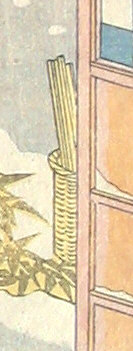
Detail of basket of what appear to be chopsticks. |
|
|
|
For those of you, like me, who did not know soba are buckwheat noodles. Zarusoba (笊蕎麦) are boiled noodles traditionally served cold on a bamboo mat or shallow bowl.
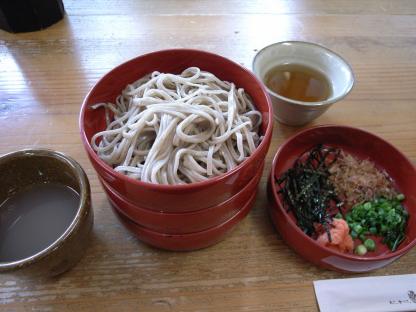
Wanko soba ( 椀子蕎麦) is a specialty of Iwate Prefecture which involves eating numerous small bowls of soba with a dipping broth which can be flavored in a multitude of various ways. "Northeastern Morioka City is famous for a tournament it holds during hare no hi [special days] festivals. This tournament is called 'Wanko soba' is conducted by having participants see how many bowls of soba they can eat in a certain time., while an attendant fills the bowl a couple of bites at a time." Quoted from: The Folk Art of Japanese Country Cooking: A Traditional Diet for Today's World, by Gaku Homma, North Atlantic Books, 1990, p. 165. The image below was posted at Wikimedia commons.
Kake soba (掛け蕎麦) is buckwheat noodles in hot broth. "...served... with ingredients like fried tofu, vegetables and meat." (Quote from: What's What in Japanese Restaurants, by Robb Satterwhite, Kodansha International, 1996, p. 71) Today both kake soba and/or kake udon come with a bowl on the side of "...shichimi (a powdered mixture of seven spices, including cayenne pepper), but it is rather spicy so be careful." (Ibid., p. 72)
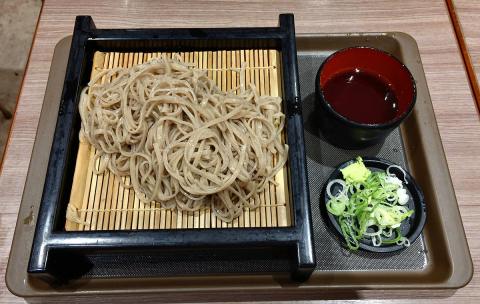
Mori soba (盛り蕎麦) "...here the noodles are piled on bamboo screens. The plain noodles are dipped in a cold broth with scallions and green Japanese horseradish (wasabi)." (Ibid., p. 71) Jim Breen's web site defines mori soba as "soba served in a shallow steaming basket." Below is a picture of mori soba found at Wikipedia commons.
Teuchi soba (手打ち蕎麦) are hand-kneaded. This is more important in modern times to stand in distinction from machine made noodles. "Some of the better restaurants serve only hand-kneaded... soba, which is prized for its texture (slightly rougher and more uneven than machine-made soba)." (Ibid. p. 72)
Tanuki soba (狸蕎麦) are tempura soba (天麩羅蕎麦). (Ibid., p. 73)
Kitsune soba (狐蕎麦) is topped with fried tofu. (Ibid.)
Tsukimi soba (月見蕎麦) or moon-viewing soba made with raw eggs and seaweed. (Ibid.)
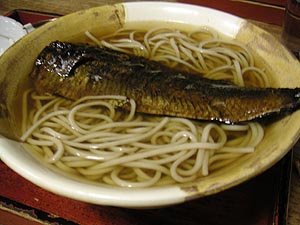
Nishin soba (鰊蕎麦) is a dish of the noodles topped with a broiled or boiled herring. (See the image below shown courtesy of Nightshadow28 at http://commons.wikimedia.org/.)
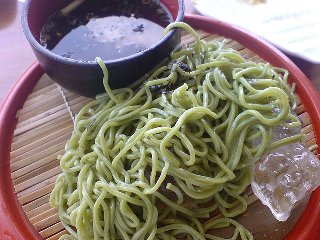
Cha-soba (茶蕎麦) which is a form of soba made with the addition of green tea. Below is a picture of cha soba posted at Flickr by punzy.
Yomogi-soba (蓬蕎麦) is soba made with mugwort. It is bright green with a slightly bitter flavor.
Toshikoshi soba (年越蕎麦) is "year-crossing" soba eaten on the eve of a new year and intended to bring long life. Its udon counterpart "...is called tsunagi udon (or tie), udon meant to symbolize tying the old and new years." (The Folk Art of Japanese Country Cooking: A Traditional Diet for Today's World, p. 51)
Jinejo soba - buckwheat soba made with a mixture of wild mountain yams. It is light brown and said to be sturdier than other soba.
Lotus root soba is lighter in color and is made by adding dried ground lotus root. It takes on its flavor.
Ito soba is thin like angel hair pasta.
And there seem to be plenty of other soba dishes. |
|||
|
|
|||
|
"The dried noodles are expensive, but there is no real substitute for their slightly nutty, appealing taste..."
Quoted from: Joy of Cooking, by Irma S. Rombauer, Marion Rombauer Becker and Ethan Becker, published by Scribner, 1997, p. 323. |
|||
|
|
|||
|
Shirley Booth, not the Academy Award winning actress of Hazel fame, in her Food in Japan (pp. 26-7) points out that buckwheat has no gluten which explains why it is often mixed with wheat flour. However, purists who want the fullest flavor buy soba which is unadulterated, but that much more expensive. Buckwheat is high in rutin which is a blood thinner and "...could be one of the contributory factors to Japan's traditionally low incidence of heart disease."
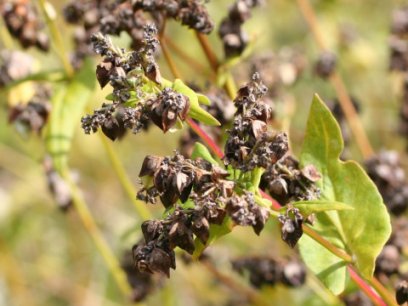
Booth (pp. 106-7) adds that buckwheat is not a grain, but the seed of a herbaceous plant. When I was younger there was an organization called the Welcome Wagon which visited new residents to my hometown. In Japan they have the custom of giving gifts of soba to new neighbors. Booth notes that this is referred to as hikkoshi soba 引越そば "...which literally means 'moving next to you.' The Japanese have many hononyms [sic], and this is one of them."
Soba noodles are often made from a combination of buckwheat flour or soba-ko (蕎麦粉) mixed with wheat flour or komugi-ko (小麦粉). |
|||
|
|
 |
|
|
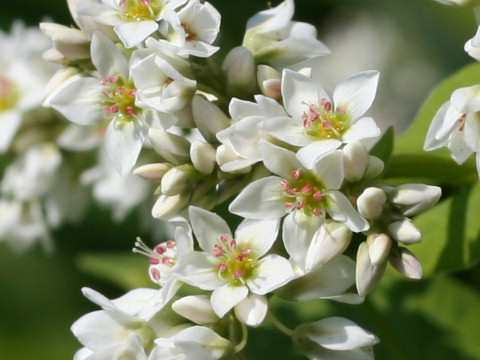
Buckwheat flowers from which the seeds are gathered for the making of soba. |
||
|
|
|
|
 |
|
|
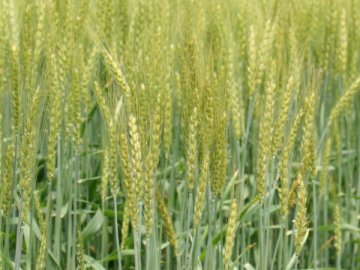
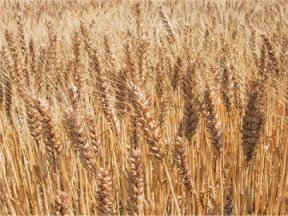
Udon noodles are made from wheat flour. |
||
|
|
|
WINK, WINK, NUDGE, NUDGE |
||
|
Anyone familiar with the Japanese language and culture knows that there are layers upon layers of meaning in almost every word, image, adage, etc. Double entendres, allusions, metaphors and puns run like a rushing underground current just below the surface of almost all traditional woodblock prints. The same is true of literature, both poetry and prose. Often these references have an element of eroticism to them. |
||
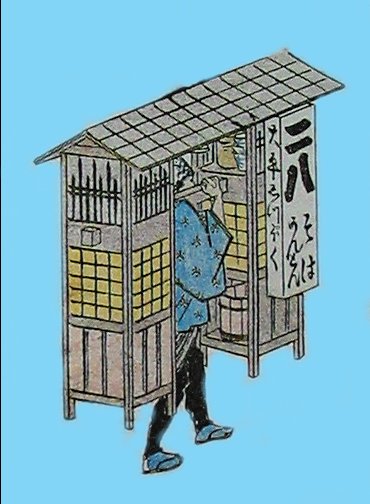 |
Detail on the left of a noodle salesman by Hiroshige. | |
| Nihachi | ||
| 二八 | ||
|
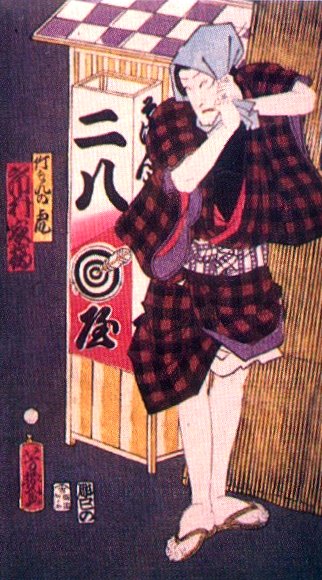
Nihachi, which is mentioned above in regards to the popular Edo combination of soba and udon noodles, also has a subtle erotic meaning. Sebastian Izzard quotes a poem by Funanoya Tsunando in which he plays upon the words nihachi and soba: "The controlling pun of the verse alludes to nihachi soba ('two-eight noodles'), noodles that cost sixteen mon a bowl. A common Japanese expression refers to a teenage girl of sixteen as nihachi, literally 'two eights'." Izzard points out that the pun has an extra punch by referring to a courtesan who claims to be sixteen, but in reality is somewhat older.*
It would seem that it can also be pronounced nippachi. |
||
| Detail to the right by Yoshiiku ca. 1863 of a man before a nihachi stand. |
 |
|
|
* Kunisada's World, by Sebastian Izzard, Japan Society, Inc., 1993, cat. #20, p. 74. |
||
|
Martha Stewart says: "Personally, I consider Japanese cuisine one of my favorites." However that doesn't stop me from liking it, too. |
|
A NOTE ON THE CHOICE OF BACKGROUND MOTIFS ON THESE WEB PAGES |
||
|
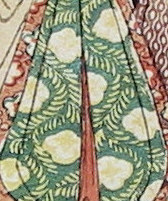
Nearly all traditional Japanese woodblock prints are remarkable in their usage of decorative motifs. Each one offers a choice of beautiful designs. Some of these patterns are used for decades while others only appear for short periods of time and are often so subtle that they go largely overlooked or taken for granted.
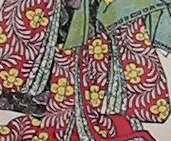
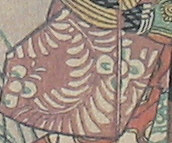
Originally when I posted this page I had chosen to utilize an imaginative floral motif which seems somewhat distantly akin to a peacock feather. (I changed it to a soba leaf wallpaper on January 31, 2008.) This particular motif does not appear in prints often. In fact, I have only run across it on a few occasions. One similar example is found on the robes of an Eizan print of "The Courtesan Tsumeikuno (?) of the Okamotoya (Okamotoya uchi Tsumeikuno?), from the series three elegant Beauties (Furyu san bijin)" which is in the collection of the Fine Arts Museums of San Francisco.* Two other Eizan prints of bijin use similar motifs: one is illustrated in Exhibition of Ukiyo-e Beauties by Kikukawa Eizan from the Riccar Museum (plate 41, 1985) dated 1816-18 while another being offered in the trade is from ca.1811-13. At least three different Edo publishers, Maruya Jimpachi, Ezakiya Kichibei and Eikyudo, utilized this motif between during this period. |
||
 |
 |
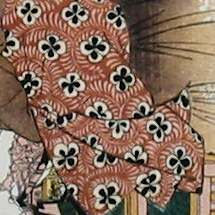 |
| Toyokuni I detail | Toyokuni I detail | Eizan detail |
|
|
||
|
|
|
|
|
Kunisada detail 1823 |
Kunisada detail ca. 1820 |
|
|
*The FAMSF on-line image base is one of the best to be found anywhere and any serious student, scholar, collector or art lover should take a look and add this site to their favorites bookmarks. |
||
|
There is a story in European art history told by Vasari about Raphael's encounter with Michelangelo's paintings. Michelangelo had displeased the Pope and fled Rome temporarily. Bramante had the keys to the Sistine Chapel and let his friend Raphael in to see the frescoes. This had a profound affect on Raphael who returned to his own work a changed man.
It would be interesting to know the exact relationships and rivalries between Ukiyo-e artists or between their publishers. Who was the first to use a particular motif? Who was the creator and who was the imitator? Perhaps we will never know and it will forever be another one of those chicken and eggs things, but it is fun to ponder. |
||
 HOME
HOME